
Track the Sun from Your Location
Did you know there are pairs of dates when the Sun rises and sets in the same places on the horizon?
This is something eclipse-watchers in Spain can use to their advantage on April 29, when the Sun sets in the same place as it will on August 12—the date of a potentially hard-to-see evening solar eclipse.
Even so, the sky rarely repeats itself exactly. Even when the Sun rises and sets in the same place, the timing can be slightly different.
Find out below how to check this for your town or city using our Sun data.
Why the Sun’s Position Matters
The New Moon on August 12, 2026, will be a special New Moon: it will produce the first total solar eclipse in mainland Europe since 1999.
Over the course of 7 minutes, the Moon’s dark umbral shadow will sweep across northern and eastern Spain, giving eclipse chasers almost 2 minutes of totality at some locations.
But there’s a snag: totality will happen at around 20:30 (8:30 pm) local time—close to sunset.
Spain is a mountainous country, and its cities, towns, and villages tend to be densely packed with buildings. This means that getting a clear, unobstructed view of the Moon and Sun at eclipse time—just a few degrees above the western horizon—will be a challenge.
Full details for the August 2026 total solar eclipse
A Shortcut That Can Help
But eclipse-watchers in Spain can use an astronomical trick to check their line of sight to the Sun well in advance: the evenings around April 29 will be an almost perfect “dress rehearsal” for the eclipse.
Why? Because April 29 and August 12 are the same number of days away from the June solstice, which, this year, falls on June 21.
Count the days between any datesHow Sunset Position Shifts—See for Yourself
Every evening, the Sun sets somewhere in the west. But the exact position changes slightly from one evening to the next.
During the six months between the December solstice and the June solstice, the point on the horizon where the Sun sets moves slowly northward. This is true wherever you live in the world (assuming you don’t live in the Arctic or Antarctic, where you lose sunrises and sunsets altogether during polar day and polar night).
On the evening of the June solstice, the Sun sets at its most northern point on the western horizon. (On the same day, the Sun rises at its most northern point on the eastern horizon.) Then, over the course of the following six months, the point where the Sun sets moves slowly southward again.
This means that there are pairs of dates—roughly the same number of days either side of the June solstice—where the Sun sets at exactly the same place on the horizon.
The specific compass direction of where the Sun sets depends on how far you are north or south of the equator. For example, in Miami, Florida, the position of sunset will be 287° on April 29 and August 12; in Boston, Massachusetts, it will be 291°.
Testing the View in Advance
In Spain, therefore, April 29 is an ideal date for anyone on the path of totality to check where the Sun is at around 20:30 (8:30 pm), and confirm whether or not they will have a clear line of sight for totality on August 12.
Because day-to-day changes in the position of sunset are fairly small, this check can also be done during the week or so before and after April 29.
One final point: why did we say earlier that this will be an almost perfect dress rehearsal? Although the Sun follows the same path across the daytime sky on both dates, the Sun’s apparent speed is slightly different.
The Sun Doesn’t Keep Perfect Time


Why are the details in the left-hand panels a little bit different in the above screenshots?
Not only is the Earth’s axis tilted with respect to the Sun—which is what gives us solstices and equinoxes—but Earth’s orbital path around the Sun isn’t perfectly circular. The Earth-Sun distance changes over the course of the year, and when Earth is closer to the Sun, it travels more quickly along its orbital path.
These two factors affect how quickly the Sun appears to move around the sky on different days of the year.
We’ve known about this for a long time—it’s why many sundials include a graph showing a “correction” that should be made to the time shown on different days of the year. This graph is known as the equation of time.
Read more about the equation of time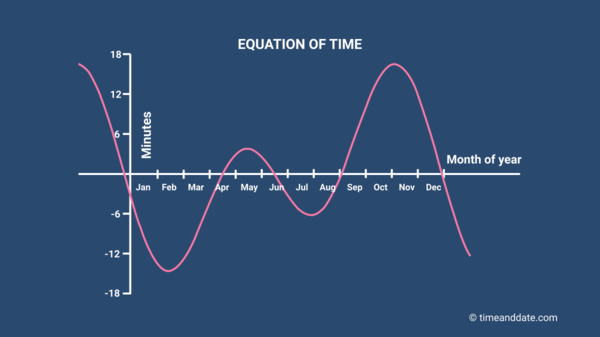
The Sun Runs a Bit Fast
The result of all this is that the Sun will be about 8 minutes “fast” on April 29 compared to August 12.
This is why, although the two screenshots from our Night Sky Map above are taken at the same time (20:33:31) on each date, the Sun is a tiny bit higher in the sky on August 12 (5.07°, compared to 3.59° on April 29).
It’s also why, if you go back to the “Sunset” column for your town or city on April 29 and August 12, you’ll see the time of sunset is about 8 minutes earlier on April 29 compared to August 12.
Check the position of sunset in April Check the position of sunset in AugustOverall, this is helpful for anyone in Spain checking their line of sight to the Sun at around 20:30 on April 29. It provides a small “safety margin” because the Sun will actually be a fraction higher in the sky at the time of totality on August 12.