
In March 2026, the Moon turned red during a total lunar eclipse. Over the next three months, you’ll hear about a Pink Moon, a Blue Moon, and a Strawberry Moon.
Unlike the Blood Moon, none of these Full Moons will actually change color. Still, the Moon can sometimes appear orange, yellow, or even blue under the right atmospheric conditions. (Hint: it’s not during the Blue Moon).
Here’s a closer look at the next three “colorful” Moons, the surprising mistake behind one of their definitions, and the real reasons the Moon sometimes changes color.
March 2026: The Moon Really Did Turn Red
On March 2–3, millions around the world witnessed a total lunar eclipse. During the event, the Full Moon took on a reddish hue, which is why these eclipses are called Blood Moons.
This color change occurs because Earth passes between the Sun and the Moon, casting its shadow on the lunar surface. While most sunlight is blocked, some sunlight still passes through Earth’s atmosphere. As this light travels through the atmosphere, shorter wavelengths scatter, leaving red and orange light to bend or refract around Earth and illuminate the Moon, giving it a reddish glow that varies depending on atmospheric conditions.
After March’s genuinely red Moon, the colorful names continue, but the colors themselves do not.
The Moon: Our natural satelliteApril 2026: The Pink Moon (Not Actually Pink)
The Full Moon in April occurs on April 2 at 02:11 UTC and is known as the Pink Moon.
Despite its name, the Moon itself does not appear pink. In fact, the reason for its name is very much Earth-based, and it is thanks to the blooming of North American pink phlox wildflowers that often bloom in April.

Before modern calendars were widely used, many Native American tribes tracked time using the cycles of the Moon. The names that they gave to Full Moons reflected seasonal changes. Other names for April’s Full Moon include the Breaking Ice Moon and the Moon of the Red Grass Appearing, both signalling the end of winter and the arrival of spring.
May 2026: The Blue Moon (Still Not Blue)
The Blue Moon is one of the more famous kinds of Moon, particularly in Western culture, where the phrase “once in a Blue Moon” refers to something that happens very rarely.
But did you know there are two kinds of Blue Moon?
There’s a seasonal Blue Moon, which is the third Full Moon in an astronomical season with four Full Moons (instead of the usual three), and there’s a monthly Blue Moon, where there are two Full Moons in a single month.
In May, we’ll be experiencing the latter since there are two Full Moons during this month: the Flower Moon, on May 1 at 17:23 UTC, followed by another, on May 31 at 08:45 UTC, making this second Full Moon the Blue Moon.
The fun thing is that a Blue Moon is not as rare as the popular phrase suggests. Whichever definition you use, a Blue Moon happens once every 2½ years or so on average.
Graham Jones, Astrophysicist, mungfali.galihkartiwa07.workers.dev
Interestingly, this type of Blue Moon is based on a misinterpretation of what a Blue Moon is. The original definition of a Blue Moon was the third Full Moon in an astronomical season with four Full Moons.
However, the mistake came about when amateur astronomer James Hugh Pruett referred to the 1937 Maine Farmers’ Almanac discussing Blue Moons, and he incorrectly interpreted the explanation to mean that a Blue Moon referred to the second Full Moon in a calendar month. The mistake spread and eventually became widely accepted in modern usage.
June 2026: The Strawberry Moon (No Hint of Red)
The Full Moon on June 29 at 23:56 UTC is known as the Strawberry Moon. Like the Pink Moon, this name comes from seasonal traditions rather than the Moon’s color.
The name refers to the short strawberry harvesting season in parts of North America, which traditionally coincides with June’s Full Moon.
Different cultures have their own names for this Moon, many of which reflect seasonal events such as ripening fruit or the beginning of summer. Despite the name, the Strawberry Moon typically appears the same pale white or gray as most other Full Moons.
What Colors Can the Moon Appear?
While most Full Moons do not change color, the Moon can sometimes appear in different hues depending on conditions in Earth’s atmosphere.
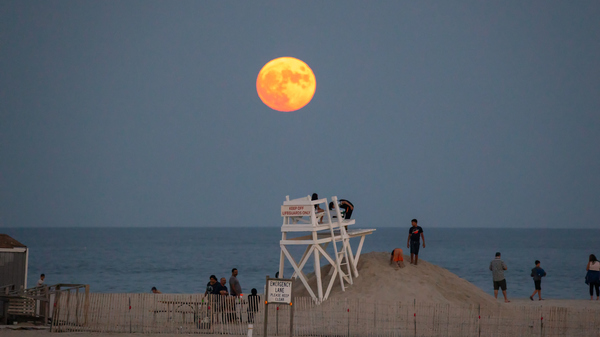
One of the most common color changes occurs when the Moon is low on the horizon, where it can appear yellow or orange.
At moonrise or moonset, the Moon’s light must pass through a thicker layer of Earth’s atmosphere. During this journey through the atmosphere, shorter wavelengths of light scatter away, leaving more red and yellow wavelengths to reach our eyes. This is the same process that makes sunsets appear orange or red, and also what causes the Moon to turn red during a total lunar eclipse.
In rare cases, the Moon can even appear blue. This can happen when particles in the atmosphere, such as volcanic ash or smoke from large wildfires, scatter red light and allow more blue light to pass through.
One famous example occurred after the 1883 eruption of Krakatoa, when volcanic ash in the atmosphere caused the Moon to appear bluish in parts of the world.
Frequently Asked Questions
Why did the Moon turn red during the March 2026 lunar eclipse?
During a total lunar eclipse, Earth moves between the Sun and the Moon, casting its shadow on the lunar surface. However, some sunlight still reaches the Moon after passing through Earth’s atmosphere.
As sunlight travels through the atmosphere, shorter wavelengths like blue and violet are scattered in different directions—a process known as Rayleigh scattering, which also makes our sky appear blue. The remaining red and orange wavelengths pass through more easily and are bent (refracted) around Earth’s edge, reaching the Moon and giving it its characteristic reddish glow.
The exact shade of red can vary depending on conditions in Earth’s atmosphere at the time, including dust, clouds, or volcanic particles.
Does the Pink Moon actually appear pink?
No. The Pink Moon gets its name from pink phlox wildflowers that bloom in early spring in North America. The Moon itself typically appears the same pale white or gray as other Full Moons.
Can the Moon ever actually appear blue?
Yes, but it is rare. The Moon can appear bluish when particles in the atmosphere—such as volcanic ash or wildfire smoke—scatter red light, allowing more blue light to pass through.
Why does the Moon sometimes look yellow or orange?
When the Moon is low on the horizon, its light passes through more of Earth’s atmosphere. This scatters shorter wavelengths, such as blue light, allowing more red and yellow light to reach our eyes, making the Moon appear yellow or orange.
Why are Full Moons given different names?
Before modern calendars were widely used, many cultures tracked time using the cycles of the Moon. In North America, Native American tribes gave each Full Moon a name reflecting seasonal changes, such as blooming flowers or harvest times. Many other cultures around the world also had their own names for the Moon.