
-
The Moon’s orbit is elliptical, so its distance from Earth changes.
-
The average distance is about 382,900 kilometers, with perigee and apogee marking the closest and farthest points.
-
Supermoons happen when a Full Moon or New Moon occurs near perigee; micromoons happen near apogee.
This summary was generated automatically and reviewed for accuracy by the article’s author. All of our content follows strict editorial guidelines. Was this helpful? Let us know.
What’s up in the sky in November?
Elliptical Orbit
The Moon’s orbit around Earth is elliptical, with one side closer to Earth than the other.
As a result, the distance between the Moon and Earth varies throughout the month and the year. On average, the distance is about 382,900 kilometers (238,000 miles) from the Moon’s center to the center of Earth.
The point on the Moon’s orbit closest to Earth is called the perigee and the point farthest away is the apogee.
Find the Moon’s distance from your location The Moon: Our natural satellite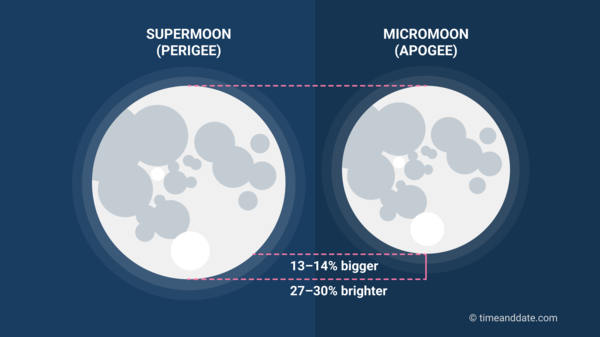
Supermoons & Micromoons
The Moon’s phase and the date of its approach to its perigee or apogee are not synced. When a Full Moon or New Moon occurs close to the Moon’s perigee, it is known as a Supermoon. On the other hand, when a Full Moon or New Moon occurs close to the Moon’s apogee, it is known as a Micromoon.
What is the Moon Illusion?The Moon passes through the 2 extreme points–or apsides–perigee and apogee about once a month. The time it takes for the Moon to travel from perigee to perigee, is called the anomalistic month, and takes around 27.55455 days.
This is not to be confused with the synodic month, which lasts a little longer, and is the time it takes the Moon to orbit once around Earth, from New Moon through all the Moon phases to the next New Moon.
Moon phases and eventsClose to Earth
The Supermoon on November 14, 2016, was the closest a Full Moon has been to Earth since January 26, 1948. The next time a Full Moon is even closer to Earth will be on November 25, 2034 (dates based onUTC time).
How can Full Moon be in the daytime?Moonrise is the best time to view the Moon, weather permitting, of course. At this time, illusion mixes with reality to make a low-hanging Moon that looks unnaturally large when compared to foreground objects.
What is lunar time?Lunar Libration
In addition to its counterclockwise orbit around Earth, the Moon rotates around its axis at a constant speed. Like all celestial objects with elliptical orbits, the Moon’s speed varies on its path around the Earth. It speeds up when it is at its perigee and slows down when it is at the apogee. This means that at its perigee, the Moon’s orbital speed is faster than its rotational speed.
When the Moon rocks slightly from north to south and wobbles a little from east to west, it is called lunar libration. This motion makes it possible, over time, to see up to 58% of the Moon’s surface from Earth, but only 50% at a time.
Why do we never see the far side of the Moon?
Perigean and Apogean Tides
The greatest difference between high and low tide is around Full Moon and New Moon, known as spring tides or king tides. During these Moon phases, the gravitational forces of the Moon and the Sun combine to pull the ocean’s water in the same direction.
Perigean spring tides have around 5 cm (2 inches) larger variation than regular spring tides, while apogean spring tides have around 5 cm (2 inches) smaller variation than normal spring tides.
Taking pictures of the MoonNatural Disaster Trigger?
Although the Sun and the Moon’s alignment cause a small increase in tectonic activity, the effects of the Supermoon on Earth are minor. Many scientists have conducted studies and haven’t found anything significant that can link the Super Moon to natural disasters.
According to NASA, the combination of the Moon being at its closest and at Full Moon, should not affect the internal energy balance of the Earth since there are lunar tides every day.
Sleep, crime, and menstruation: how the Moon affects humans