
| Current Time: | Nov 18, 2026 at 12:25:49 am |
|---|---|
| Moon Direction: | ↑ 260° West |
| Moon Altitude: | -1.8° |
| Moon Distance: | 245,118 mi |
| Next Full Moon: | Nov 24, 2026, 11:53 am |
| Next New Moon: | Dec 8, 2026, 9:51 pm |
| Next Moonrise: | Today, 12:36 pm |
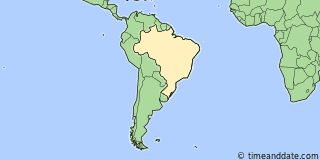

Moonrise, Moonset, and Phase Calendar for 3°24'26.6"S, 41°26'52.5"W, October 2026
Scroll right to see more
| 2026 | Moonrise/Moonset | Meridian Passing | ||||||||
|---|---|---|---|---|---|---|---|---|---|---|
| Oct | Moonrise | Moonset | Moonrise | Time | Distance (mi) | Illumination | ||||
| 1 | - | 9:33 am | ↑ (297°) | 10:20 pm | ↑ (62°) | 3:25 am | (59.5°) | 229,566 | 75.3% | |
| 2 | - | 10:35 am | ↑ (298°) | 11:23 pm | ↑ (62°) | 4:28 am | (58.1°) | 229,531 | 64.3% | |
 3 |
- | 11:38 am | ↑ (297°) | - | 5:31 am | (58.8°) | 229,887 | 52.5% | ||
| 4 | 12:24 am | ↑ (64°) | 12:39 pm | ↑ (294°) | - | 6:31 am | (61.5°) | 230,573 | 40.6% | |
| 5 | 1:20 am | ↑ (68°) | 1:35 pm | ↑ (289°) | - | 7:27 am | (65.7°) | 231,554 | 29.4% | |
| 6 | 2:12 am | ↑ (73°) | 2:28 pm | ↑ (284°) | - | 8:20 am | (71.1°) | 232,821 | 19.4% | |
| 7 | 3:00 am | ↑ (79°) | 3:18 pm | ↑ (277°) | - | 9:08 am | (77.3°) | 234,383 | 11.2% | |
| 8 | 3:45 am | ↑ (86°) | 4:05 pm | ↑ (271°) | - | 9:54 am | (83.9°) | 236,241 | 5.1% | |
| 9 | 4:28 am | ↑ (92°) | 4:51 pm | ↑ (265°) | - | 10:39 am | (89.6°) | 238,376 | 1.4% | |
 10 |
5:11 am | ↑ (99°) | 5:37 pm | ↑ (258°) | - | 11:24 am | (83.3°) | 240,728 | 0.1% | |
| 11 | 5:55 am | ↑ (104°) | 6:24 pm | ↑ (253°) | - | 12:09 pm | (77.6°) | 243,192 | 1.2% | |
| 12 | 6:40 am | ↑ (109°) | 7:13 pm | ↑ (249°) | - | 12:56 pm | (72.7°) | 245,622 | 4.4% | |
| 13 | 7:27 am | ↑ (113°) | 8:03 pm | ↑ (245°) | - | 1:45 pm | (68.9°) | 247,841 | 9.5% | |
| 14 | 8:16 am | ↑ (116°) | 8:55 pm | ↑ (243°) | - | 2:35 pm | (66.4°) | 249,661 | 16.1% | |
| 15 | 9:07 am | ↑ (118°) | 9:47 pm | ↑ (242°) | - | 3:27 pm | (65.2°) | 250,905 | 24.0% | |
| 16 | 9:58 am | ↑ (118°) | 10:38 pm | ↑ (243°) | - | 4:18 pm | (65.5°) | 251,425 | 32.8% | |
| 17 | 10:49 am | ↑ (117°) | 11:27 pm | ↑ (245°) | - | 5:08 pm | (67.1°) | 251,124 | 42.2% | |
 18 |
11:39 am | ↑ (114°) | - | - | 5:57 pm | (69.9°) | 249,972 | 52.0% | ||
| 19 | - | 12:14 am | ↑ (248°) | 12:27 pm | ↑ (110°) | 6:44 pm | (73.9°) | 248,005 | 61.8% | |
| 20 | - | 12:59 am | ↑ (252°) | 1:14 pm | ↑ (106°) | 7:28 pm | (78.8°) | 245,336 | 71.3% | |
| 21 | - | 1:42 am | ↑ (257°) | 1:59 pm | ↑ (100°) | 8:12 pm | (84.5°) | 242,143 | 80.2% | |
| 22 | - | 2:24 am | ↑ (263°) | 2:44 pm | ↑ (94°) | 8:56 pm | (89.3°) | 238,668 | 88.0% | |
| 23 | - | 3:07 am | ↑ (269°) | 3:31 pm | ↑ (88°) | 9:41 pm | (82.7°) | 235,189 | 94.2% | |
| 24 | - | 3:50 am | ↑ (275°) | 4:19 pm | ↑ (81°) | 10:28 pm | (76.2°) | 232,001 | 98.3% | |
| 25 | - | 4:37 am | ↑ (282°) | 5:10 pm | ↑ (75°) | 11:19 pm | (70.0°) | 229,375 | 99.8% | |
 26 |
- | 5:27 am | ↑ (288°) | 6:06 pm | ↑ (70°) | Moon does not pass the meridian on this day. | ||||
| 27 | - | 6:22 am | ↑ (293°) | 7:06 pm | ↑ (65°) | 12:14 am | (64.6°) | 227,524 | 98.6% | |
| 28 | - | 7:22 am | ↑ (296°) | 8:10 pm | ↑ (63°) | 1:14 am | (60.6°) | 226,568 | 94.3% | |
| 29 | - | 8:26 am | ↑ (298°) | 9:15 pm | ↑ (62°) | 2:18 am | (58.5°) | 226,518 | 87.4% | |
| 30 | - | 9:31 am | ↑ (297°) | 10:18 pm | ↑ (64°) | 3:23 am | (58.6°) | 227,279 | 78.1% | |
| 31 | - | 10:33 am | ↑ (295°) | 11:16 pm | ↑ (67°) | 4:25 am | (60.7°) | 228,682 | 67.4% | |
| * All times are local time for 3°24'26.6"S, 41°26'52.5"W. They take into account refraction. Dates are based on the Gregorian calendar. Illumination is calculated at lunar noon. | ||||||||||
Jan | Feb | Mar | Apr | May | Jun | Jul | Aug | Sep | Oct | Nov | Dec
Elsewhere on mungfali.galihkartiwa07.workers.dev

Look Up for the Leonids
The Leonids come with a bonus this year: A Mars-Jupiter close approach will be visible near the meteor shower’s radiant. Find out when and where to see them.

Sky Guide for November 2026
The planets are putting on a show this month. Up next, Mars and Jupiter meet in the sky.

The Moon in November 2026
Discover the phases of the Moon in November 2026, including a brand new Supermoon.

Full Moon Phase: How Does It Work?
The third primary phase of the Moon is the Full Moon.