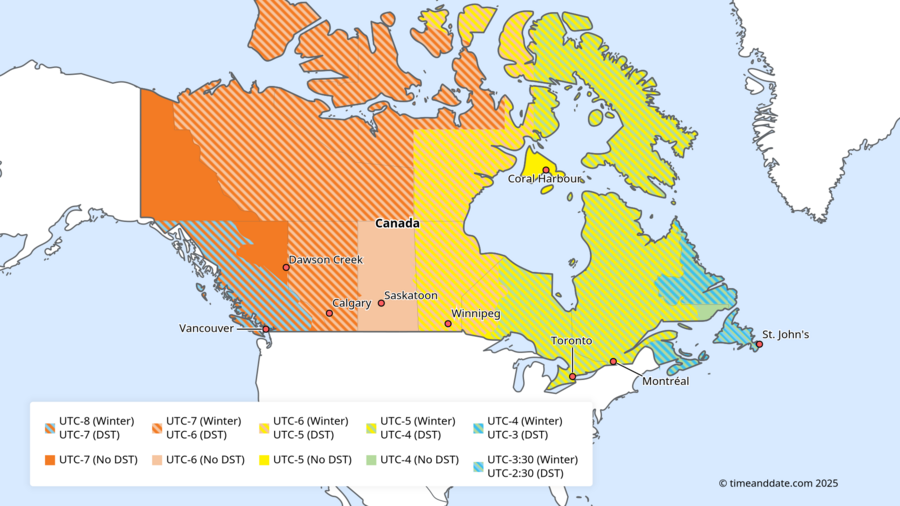
March 2, 2026: British Columbia (BC) will adopt Permanent Daylight Saving Time .
The one-hour clock change on March 8, 2026, will be the province’s final seasonal time shift. After that, most of British Columbia (BC) will remain on Daylight Saving Time year-round, eliminating the next scheduled clock change on November 1.
Most people living in Canada will set their clocks forward one hour from 02:00 (2 am) to 03:00 (3 am) local time on March 8, 2026.
Standard time, also known as winter time, will resume on Sunday, November 1, 2026.
Canada clock change in detailMost of the United States will also begin DST on the same date.
Longer than in Europe
In 2007, the United States and Canada moved to an earlier “spring forward” and a later “fall back,” extending the DST season to 238 days (34 weeks). This effectively shifts an hour of daylight from morning to evening for much of the year.
In Europe, DST runs from the last Sunday in March to the last Sunday in October, making it typically 21 or 28 days shorter than in the US and Canada, depending on how the Sundays fall in a given calendar year. In 2026, DST in Europe starts three weeks later than in Canada, on March 29, 2026.
DST Change in Canada
Clocks will change in almost all areas in Canada, except:
Canada Moves Toward Ending Clock Changes
Several Canadian provinces, including British Columbia (BC), Ontario, and Alberta, have pushed to end Daylight Saving Time (DST), but progress remains slow.
In Quebec, a public consultation held in 2024 gathered more than 214,000 responses, with 91% of participants saying they want to stop changing the clocks twice a year. Among those, 72% preferred keeping summer time year-round.
Quebec will make its own decision and isn’t bound by the choices of its neighbours.
Simon Jolin-Barrette, Quebec Justice Minister,
globalnews.caThe government noted that further consultations are needed before any final decision is made.
BC introduced a legislative amendment in 2019 to stay on permanent DST, but is waiting for Washington, Oregon, and California to take action to maintain alignment.
UPDATE, March 2, 2026: British Columbia (BC) announced it will stay on permanent DST. After the clock change on March 8, 2026, much of the province will remain on UTC−7 year-round, eliminating the next scheduled clock change on November 1.
This decision isn‘t just about clocks. It’s about making life easier for families, reducing disruptions for businesses and supporting a stable, thriving economy. I am hopeful that our American neighbours will soon join us in ending disruptive time changes.
BC Premier David Eby
news.gov.bc.caOntario passed the Time Amendment Act in 2020 to enable permanent DST. However, the change has not been implemented, and the province has indicated it would prefer to move forward only in coordination with Quebec and New York State to maintain economic and cross-border alignment.
In 2021, Alberta held a referendum on abolishing the biannual time change. The public vote narrowly favored retaining the system of twice-yearly clock adjustments. 50.2% voted to continue changing clocks twice a year.
History of DST
Germany and Austria were among the first countries to adopt DST nationally in 1916, but a Canadian city did it earlier: On July 1, 1908, Port Arthur, Ontario—today part of Thunder Bay—set clocks forward one hour, marking the world’s first DST period.
Set clocks forward or back?Other Locations That Change
Several other locations in the Atlantic region will also start DST on March 8, 2026, including Cuba, Bermuda, The Bahamas, Saint Pierre and Miquelon, and Thule Air Base in Greenland.
Upcoming DST changesFrequently Asked DST Questions
What is DST?
Daylight Saving Time (DST) is the practice of setting the clocks forward during part of the year to make better use of natural daylight. Changing the clocks does not create extra daylight, but it shifts civil time in relation to solar time. In other words, sunrise and sunset happen an hour later, on the clock, when DST is in effect.
Is Summer Time the Same as DST?
Saying “summer time” instead of Daylight Saving Time (DST) is common in many countries, especially in the United Kingdom. The term winter time is sometimes used instead of standard time, which is the official name for the period without DST.
Is DST bad for your health?
Daylight Saving Time (DST) can mess with our body clock and can trigger underlying health issues. This time change can cause disruptions to our body clock, otherwise known as the circadian rhythm.