When Do Clocks Change in Europe?
Clocks in most European countries are turned back by 1 hour at 01:00 UTC on October 25, 2026.
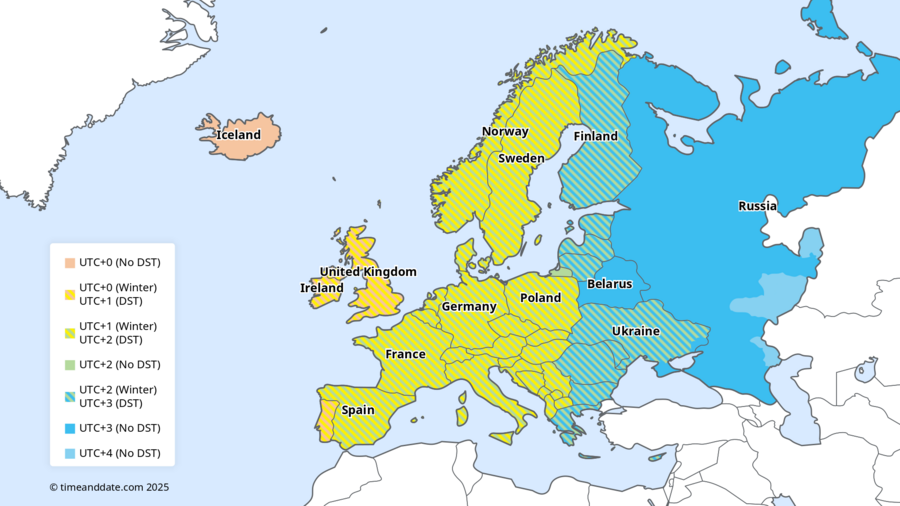
Since Europe spans several time zones, the switch from summer time to standard time (also known as winter time or normal time) occurs at different local times—see table further down.
DST in Europe starts again on Sunday, March 28, 2027.
Check your local time for the Europe DST end 2026EU’s Plan to Scrap DST Still Stuck
More than seven years after the European Parliament voted in favor of scrapping the twice-yearly clock change, Europeans are still turning their clocks forward and back.
The European Commission’s draft directive aimed to stop the one-hour clock change, with the European Parliament voting in 2019 for the practice to end by 2021. But the proposal has stalled in the Council of the European Union, mainly amid practical concerns, including coordination between Member States, and the implications of countries choosing different permanent time zones.
The Council has still not agreed on a common position, meaning the current system of seasonal clock changes remains in place.
The issue resurfaced in October 2025, when Spanish Prime Minister Pedro Sánchez renewed calls to end clock changes, arguing the current system barely saves energy and harms health: “In all the surveys in which Spaniards and Europeans are asked, the majority are against changing the time,” he said, vowing to push again in 2026.
Since then, the European Commission has launched a new study into the impacts of ending seasonal clock changes, but there has still been no further progress on the proposal, and the twice-yearly clock changes remain in place for now.
Europe’s time zones and DST scheduleShorter than in the US and Canada
The US (except for Arizona and Hawaii) and the provinces and territories in Canada that observe DST will end it a week after Europe, on November 1, 2026.
US clock change in detailDST in Europe is 21 or 28 days shorter than in the US and Canada, depending on the year.
Daylight Saving Time in Europe
Most European countries coordinate their time changes. Under current EU law, Directive 2000/84/EC , DST runs from 01:00 UTC on the last Sunday of March to 01:00 UTC on the last Sunday of October every year.
Participating countries are:
Countries that do not observe DST include Russia, Iceland, and Belarus.
Current local times in EuropeFrequently Asked DST Questions
What is DST?
Daylight Saving Time (DST) is the practice of setting the clocks forward during part of the year to make better use of natural daylight. Changing the clocks does not create extra daylight, but it shifts civil time in relation to solar time. In other words, sunrise and sunset happen an hour later, on the clock, when DST is in effect.
Is Summer Time the same as DST?
Saying “summer time” instead of Daylight Saving Time (DST) is common in many countries, like the United Kingdom. The term winter time is sometimes used instead of standard time, which is the official name for the period without DST.
Is DST bad for your health?
Daylight Saving Time (DST) can mess with our body clock and can trigger underlying health issues. This time change can cause disruptions to our body clock, otherwise known as the circadian rhythm.