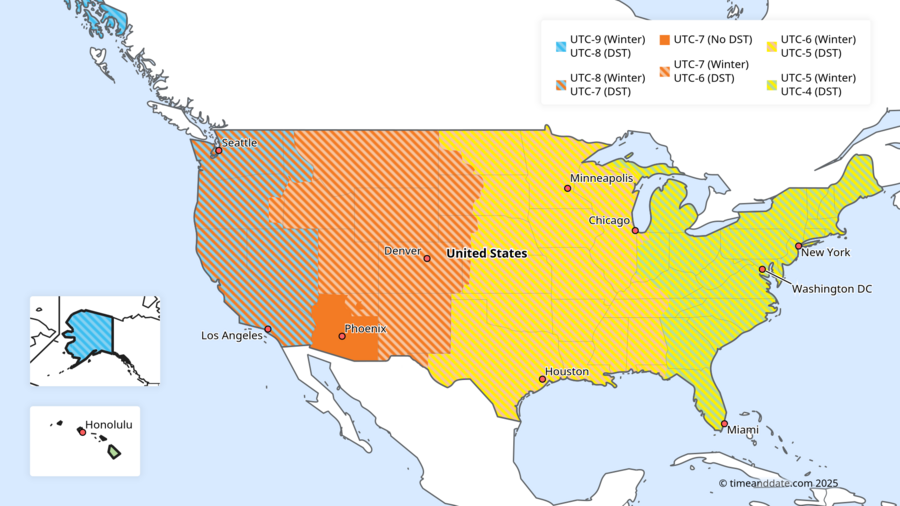
Clocks will be set back 1 hour from 02:00 (2 am) to 01:00 (1 am), local time, on Sunday, November 1, 2026.
US clock change in detailSeveral Canadian provinces and territories have adopted permanent time or are moving toward it—read more below. Canadians in areas that continue to observe seasonal clock changes will set their clocks back one hour from 02:00 (2 am) to 01:00 (1 am) local time on November 1, 2026.
In areas of the US and Canada that continue to observe seasonal clock changes, DST starts again on Sunday, March 14, 2027.
Affects Most of the USA
Clocks will be set back one hour in 48 states, including:
The following areas do not observe DST and will not change their clocks:

Some in the US Want to Abolish DST
Changing the clocks twice a year remains controversial and continues to prompt political debate on both sides of the Atlantic.
The United States House of Representatives passed a bill on July 14, 2026 that would make Daylight Saving Time permanent if enacted. The Sunshine Protection Act received bipartisan support , passing by 308 votes to 117.
It now awaits consideration in the Senate, the upper chamber of the US Congress, where the measure has so far drawn both support and opposition.
It would push winter sunrises to an absurdly late hour (...) kids would either walk to school in the pitch black or schools would have to push back start times.
Senator Tom Cotton of Arkansas
The HillPresident Donald Trump supports ending seasonal clock changes and making DST permanent in the US.
If the Sunshine Protection Act is enacted, most of the United States would cease to change its clocks twice a year and would observe Daylight Saving Time year-round. Areas that currently do not observe DST would not be required to adopt it.
DST in Canada
Several Canadian provinces and territories have adopted permanent time or are moving toward it, including Yukon, British Columbia, Alberta, and the Northwest Territories.
Yukon decided to adopt permanent UTC−7 in 2020.
On March 2, 2026, British Columbia announced it would stay on permanent DST after the clock change on March 8, 2026. Most of the province now observes UTC−7 year-round.
On June 18, 2026, Alberta brought its new Official Time Act into force. The province will now observe UTC−6 year-round, meaning clocks will no longer be set back one hour on November 1, 2026.
Manitoba will remain on UTC−5 year-round and will not set its clocks back on November 1.
Canadians in areas that continue to observe seasonal clock changes will set their clocks back one hour from 02:00 (2 am) to 01:00 (1 am) local time on November 1, 2026.
Canada clock changes in detailOther Locations That Change
DST will also end on November 1, 2026, in Cuba, Bermuda, the Bahamas, Saint Pierre and Miquelon, and Pituffik Space Base in Greenland.
Upcoming DST changes worldwideLonger than in Europe
In Europe, DST will end a week before the US on October 25, 2026.
The Energy Policy Act of 2005, signed by President George W. Bush, extended Daylight Saving Time to 238 days per year, starting in 2007. This change provided Americans with more evening daylight for most of the year. By comparison, Daylight Saving Time in Europe lasts 210 or 217 days per year, depending on how the Sundays fall in a given calendar year.
Set Clocks Back or Ahead?
Daylight Saving Time (DST) shifts the local sunrise and sunset times forward one hour, resulting in more evening daylight. To remember which way to set your watch, keep in mind one of these sayings: “spring forward, fall back” or “spring ahead, fall behind.”
The clocks spring ahead (= losing one hour) in the spring when DST starts, and they fall behind one hour (= gaining one hour) when DST ends in the fall.
Frequently Asked DST Questions
What is DST?
Daylight Saving Time (DST) is the practice of setting the clocks forward during part of the year to make better use of natural daylight. Changing the clocks does not create extra daylight, but it shifts civil time in relation to solar time. In other words, sunrise and sunset happen an hour later, on the clock, when DST is in effect.
Is Summer Time the same as DST?
Saying “summer time” instead of Daylight Saving Time (DST) is common in many countries, like the United Kingdom. The term winter time is sometimes used instead of standard time, which is the official name for the period without DST.
Is DST bad for your health?
Daylight Saving Time (DST) can mess with our body clock and can trigger underlying health issues. This time change can cause disruptions to our body clock, otherwise known as the circadian rhythm.