
Mar 14, 2027, 2:00 am
In most of USA
| Country: | United States |
|---|---|
| Long Name: | United States of America |
| Abbreviations: | US, USA |
| Capital: | Washington DC |
| Time Zones: | 6 (Main Country) |
| Total Time Zones: | 12 (with dependencies) |
| Dial Code: | +1 |
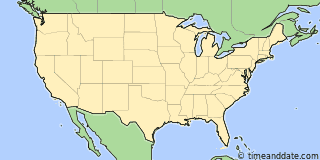

Note: Only some parts of USA used DST in 1953.
Apr 26
Forward 1 hour
Apr 26, 1953 - Daylight Saving Time Started
When local standard time was about to reach
Sunday, April 26, 1953, 2:00:00 am clocks were turned forward 1 hour to
Sunday, April 26, 1953, 3:00:00 am local daylight time instead.
Sunrise and sunset were about 1 hour later on Apr 26, 1953 than the day before. There was more light in the evening and less light in the morning.
Also called Spring Forward, Summer Time, and Daylight Savings Time.
Sep 27
Back 1 hour
Sep 27, 1953 - Daylight Saving Time Ended
When local daylight time was about to reach
Sunday, September 27, 1953, 2:00:00 am clocks were turned backward 1 hour to
Sunday, September 27, 1953, 1:00:00 am local standard time instead.
Sunrise and sunset were about 1 hour earlier on Sep 27, 1953 than the day before. There was more light in the morning and less light in the evening.
Also called Fall Back and Winter Time.
Other years: 2026
When Does DST Start and End in the US?
Daylight Saving Time (DST) in most of the United States starts on the second Sunday in March and ends on the first Sunday in November.
Which States and Federal Districts use Daylight Saving Time in 1953

Areas in United States on standard time all of 1953
DST in States and Federal Districts in USA in 1953
|
|||||
|---|---|---|---|---|---|
| Alabama | Apr 26 – Sep 27 | Kentucky (south) | No DST | Ohio | Apr 26 – Sep 27 |
| Alaska | No DST | Louisiana | Apr 26 – Sep 27 | Oklahoma | Apr 26 – Sep 27 |
| Arizona | No DST | Maine | Apr 26 – Sep 27 | Oregon (east) | No DST |
| Arkansas | Apr 26 – Sep 27 | Maryland | Apr 26 – Sep 27 | Oregon | Apr 26 – Sep 27 |
| California | Apr 26 – Sep 27 | Massachusetts | Apr 26 – Sep 27 | Pennsylvania | Apr 26 – Sep 27 |
| Colorado | No DST | Michigan | No DST | Rhode Island | Apr 26 – Sep 27 |
| Connecticut | Apr 26 – Sep 27 | Minnesota | Apr 26 – Sep 27 | South Carolina | Apr 26 – Sep 27 |
| Delaware | Apr 26 – Sep 27 | Mississippi | Apr 26 – Sep 27 | South Dakota (west) | No DST |
| District of Columbia | Apr 26 – Sep 27 | Missouri | Apr 26 – Sep 27 | South Dakota | Apr 26 – Sep 27 |
| Florida | Apr 26 – Sep 27 | Montana | No DST | Tennessee | Apr 26 – Sep 27 |
| Georgia | Apr 26 – Sep 27 | Nebraska (west) | No DST | Texas (west) | No DST |
| Hawaii | No DST | Nebraska | Apr 26 – Sep 27 | Texas | Apr 26 – Sep 27 |
| Idaho (north) | Apr 26 – Sep 27 | Nevada | Apr 26 – Sep 27 | Utah | No DST |
| Idaho | No DST | New Hampshire | Apr 26 – Sep 27 | Vermont | Apr 26 – Sep 27 |
| Illinois | Apr 26 – Sep 27 | New Jersey | Apr 26 – Sep 27 | Virginia | Apr 26 – Sep 27 |
| Indiana | Apr 26 – Sep 27 | New Mexico | No DST | Washington | Apr 26 – Sep 27 |
| Indiana (south) | No DST | New York | Apr 26 – Sep 27 | West Virginia | Apr 26 – Sep 27 |
| Iowa | Apr 26 – Sep 27 | North Carolina | Apr 26 – Sep 27 | Wisconsin | Apr 26 – Sep 27 |
| Kansas | Apr 26 – Sep 27 | North Dakota (mid-west, mid-west, southwest) | No DST | Wyoming | No DST |
| Kentucky (eastern part, western part) | Apr 26 – Sep 27 | North Dakota | Apr 26 – Sep 27 | ||
Which States Don't Use DST?
Most of Arizona and Hawaii don't use DST. Indiana introduced DST in 2006.
Daylight Saving Time in Dependencies of USA
| Dependency | Type | Daylight Saving Time Period |
|---|---|---|
| American Samoa | Unincorp. unorg. territory | No Daylight Saving Time |
| Guam | Unincorp. org. territory | No Daylight Saving Time |
| Northern Mariana Islands | Unincorp. org. territory | No Daylight Saving Time |
| Puerto Rico | Unincorp. org. territory | No Daylight Saving Time |
| US Minor Outlying Islands | Territory | No Daylight Saving Time |
| US Virgin Islands | Unincorp. org. territory | No Daylight Saving Time |
US dependencies do not use Daylight Saving Time (DST).
Daylight Saving Time History in United States
- United States first observed Daylight Saving Time in 1918.
- United States has observed DST for 109 years between 1918 and 2026 (DST in at least one location).
- See Worldwide DST Statistics
DST in the USA Today
Daylight Saving Time (DST) in the USA starts on the second Sunday in March and ends on the first Sunday in November. The current schedule was introduced in 2007 and follows the Energy Policy Act of 2005.
According to section 110 of the act, the US Department of Transportation (DOT) governs the use of DST. The law does not affect the rights of the states and territories that choose not to observe DST.
Confusing DST Rules
Historically, there were no uniform rules for DST from 1945 to 1966. This caused widespread confusion, especially in transport and broadcasting. The Uniform Time Act of 1966 aligned the switch dates across the USA for the first time.
Following the 1973 oil embargo, the US Congress extended the DST period to 10 months in 1974 and 8 months in 1975, in an effort to save energy.
After the energy crisis was over in 1976, the DST schedule in the US was revised several times. From 1987 to 2006, the country observed DST for about 7 months each year.