
Aurora Alert: Major X-Flares and an Incoming CME
After a burst of intense solar activity, the northern lights could glow farther from the usual polar regions around February 5.
Search for a city's moon distances:
Minumum (perigee) and maximum (apogee) distances from the Moon to the Earth.
Local time history for years before 1970 is not available for Columbus.
Instead, local time for New York is used for years before 1970.
The Moon Distance Calculator calculates the approximate minumum and maximum distances from the Moon to the Earth.
The Moon's distance to Earth varies. The two extreme points of the Moon’s orbit each month are known as the lunar perigee and apogee. The table below shows the time of lunar perigee and apogee.
| Date | Local Time | Distance in km | Distance in miles |
|---|---|---|---|
| Jan 13 | 12:58 am | 369,669 km | 229,702 mi |
| Feb 6 | 7:19 pm | 368,327 km | 228,868 mi |
| Mar 6 | 8:21 am | 362,808 km | 225,438 mi |
| Apr 3 | 3:03 pm | 358,523 km | 222,776 mi |
| May 2 | 2:44 am | 356,897 km | 221,765 mi |
| May 30 | 12:13 pm | 358,199 km | 222,575 mi |
| Jun 27 | 5:25 pm | 361,952 km | 224,906 mi |
| Jul 25 | 9:21 am | 366,919 km | 227,993 mi |
| Aug 20 | 12:26 am | 369,729 km | 229,739 mi |
| Sep 15 | 3:35 am | 366,026 km | 227,438 mi |
| Oct 12 | 11:22 pm | 360,871 km | 224,235 mi |
| Nov 10 | 7:50 am | 357,343 km | 222,043 mi |
| Dec 8 | 8:31 pm | 356,831 km | 221,724 mi |
| * Distances are approximate. Closest Approach (Perigee) is highlighted. | |||
| Date | Local Time | Distance in km | Distance in miles |
|---|---|---|---|
| Jan 25 | 4:33 pm | 404,278 km | 251,207 mi |
| Feb 22 | 1:10 pm | 404,808 km | 251,536 mi |
| Mar 22 | 5:50 am | 405,747 km | 252,119 mi |
| Apr 18 | 2:26 pm | 406,438 km | 252,549 mi |
| May 15 | 5:46 pm | 406,519 km | 252,599 mi |
| Jun 12 | 2:07 am | 405,913 km | 252,223 mi |
| Jul 9 | 5:00 pm | 404,926 km | 251,609 mi |
| Aug 6 | 10:49 am | 404,248 km | 251,188 mi |
| Sep 3 | 5:51 am | 404,381 km | 251,270 mi |
| Sep 30 | 11:34 pm | 405,233 km | 251,800 mi |
| Oct 28 | 2:37 pm | 406,155 km | 252,373 mi |
| Nov 24 | 7:28 pm | 406,512 km | 252,595 mi |
| Dec 21 | 8:33 pm | 406,280 km | 252,451 mi |
| * Distances are approximate. Furthest Apart (Apogee) is highlighted. | |||
After a burst of intense solar activity, the northern lights could glow farther from the usual polar regions around February 5.
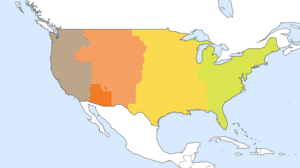
Most of the United States begins Daylight Saving Time (DST) on Sunday, March 8, 2026. A new poll shows only 12% support the current system.

What’s up in the day and night sky in February 2026, including a string of close Moon-planet meetups and an annular solar eclipse.

Discover the phases of the Moon in February 2026. Also: Will the crew of Artemis II fly around the Moon in February?