
Aurora Alert: Major X-Flares and an Incoming CME
After a burst of intense solar activity, the northern lights could glow farther from the usual polar regions around February 5.
Search for a city's moon distances:
Minumum (perigee) and maximum (apogee) distances from the Moon to the Earth.
The Moon Distance Calculator calculates the approximate minumum and maximum distances from the Moon to the Earth.
The Moon's distance to Earth varies. The two extreme points of the Moon’s orbit each month are known as the lunar perigee and apogee. The table below shows the time of lunar perigee and apogee.
| Date | Local Time | Distance in km | Distance in miles |
|---|---|---|---|
| Jan 4 | 12:22 am | 365,361 km | 227,025 mi |
| Feb 1 | 2:28 am | 360,088 km | 223,748 mi |
| Mar 1 | 1:17 pm | 357,183 km | 221,943 mi |
| Mar 30 | 2:09 am | 357,446 km | 222,106 mi |
| Apr 27 | 10:37 am | 360,572 km | 224,049 mi |
| May 25 | 8:54 am | 365,419 km | 227,061 mi |
| Jun 20 | 9:27 pm | 369,516 km | 229,606 mi |
| Jul 16 | 5:20 am | 367,670 km | 228,460 mi |
| Aug 12 | 5:16 pm | 362,713 km | 225,380 mi |
| Sep 9 | 9:46 pm | 358,591 km | 222,818 mi |
| Oct 8 | 8:10 am | 356,829 km | 221,723 mi |
| Nov 5 | 8:07 pm | 358,105 km | 222,516 mi |
| Dec 4 | 3:20 am | 362,270 km | 225,104 mi |
| Dec 31 | 7:23 pm | 367,922 km | 228,616 mi |
| * Distances are approximate. Closest Approach (Perigee) is highlighted. | |||
| Date | Local Time | Distance in km | Distance in miles |
|---|---|---|---|
| Jan 20 | 2:04 am | 405,291 km | 251,836 mi |
| Feb 16 | 2:58 pm | 406,066 km | 252,318 mi |
| Mar 15 | 5:58 pm | 406,366 km | 252,504 mi |
| Apr 11 | 10:26 pm | 406,059 km | 252,313 mi |
| May 9 | 12:25 pm | 405,166 km | 251,758 mi |
| Jun 6 | 6:13 am | 404,288 km | 251,213 mi |
| Jul 4 | 12:55 am | 404,091 km | 251,091 mi |
| Jul 31 | 7:12 pm | 404,733 km | 251,489 mi |
| Aug 28 | 11:26 am | 405,758 km | 252,126 mi |
| Sep 24 | 9:32 pm | 406,441 km | 252,551 mi |
| Oct 21 | 11:15 pm | 406,436 km | 252,548 mi |
| Nov 18 | 5:41 am | 405,833 km | 252,173 mi |
| Dec 15 | 10:29 pm | 404,905 km | 251,596 mi |
| * Distances are approximate. Furthest Apart (Apogee) is highlighted. | |||
After a burst of intense solar activity, the northern lights could glow farther from the usual polar regions around February 5.
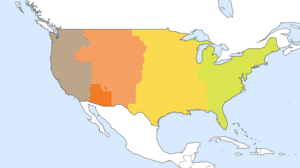
Most of the United States begins Daylight Saving Time (DST) on Sunday, March 8, 2026. A new poll shows only 12% support the current system.

What’s up in the day and night sky in February 2026, including a string of close Moon-planet meetups and an annular solar eclipse.

Discover the phases of the Moon in February 2026. Also: Will the crew of Artemis II fly around the Moon in February?