| Current Time: | Nov 26, 2026 at 4:13:43 am |
|---|---|
| Moon Direction: | ↑ 291° Northwest |
| Moon Altitude: | 64.8° |
| Moon Distance: | 223,334 mi |
| Next New Moon: | Dec 9, 2026, 12:51 am |
| Next Full Moon: | Dec 24, 2026, 1:28 am |
| Next Moonset: | Today, 9:27 am |
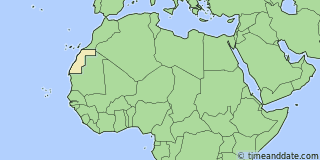

Moonrise, Moonset, and Phase Calendar for 20°46'09.4"N, 17°03'27.6"W, February 2026
Scroll right to see more
| 2026 | Moonrise/Moonset | Meridian Passing | ||||||||
|---|---|---|---|---|---|---|---|---|---|---|
| Feb | Moonrise | Moonset | Moonrise | Time | Distance (mi) | Illumination | ||||
 1 |
- | 8:26 am | ↑ (294°) | 7:46 pm | ↑ (69°) | 1:36 am | (87.4°) | 229,028 | 98.9% | |
| 2 | - | 9:11 am | ↑ (288°) | 8:48 pm | ↑ (75°) | 2:31 am | (87.5°) | 231,092 | 99.9% | |
| 3 | - | 9:51 am | ↑ (282°) | 9:46 pm | ↑ (82°) | 3:22 am | (81.6°) | 233,826 | 98.3% | |
| 4 | - | 10:26 am | ↑ (275°) | 10:40 pm | ↑ (89°) | 4:09 am | (75.1°) | 237,016 | 94.1% | |
| 5 | - | 11:00 am | ↑ (268°) | 11:33 pm | ↑ (95°) | 4:53 am | (68.6°) | 240,395 | 88.0% | |
| 6 | - | 11:33 am | ↑ (261°) | - | 5:35 am | (62.3°) | 243,683 | 80.3% | ||
| 7 | 12:25 am | ↑ (102°) | 12:06 pm | ↑ (255°) | - | 6:18 am | (56.4°) | 246,614 | 71.6% | |
| 8 | 1:17 am | ↑ (108°) | 12:41 pm | ↑ (250°) | - | 7:01 am | (51.2°) | 248,965 | 62.2% | |
 9 |
2:09 am | ↑ (112°) | 1:19 pm | ↑ (246°) | - | 7:46 am | (46.8°) | 250,569 | 52.5% | |
| 10 | 3:03 am | ↑ (116°) | 2:01 pm | ↑ (242°) | - | 8:33 am | (43.4°) | 251,331 | 42.7% | |
| 11 | 3:57 am | ↑ (119°) | 2:47 pm | ↑ (240°) | - | 9:23 am | (41.1°) | 251,225 | 33.3% | |
| 12 | 4:50 am | ↑ (121°) | 3:38 pm | ↑ (239°) | - | 10:14 am | (40.2°) | 250,300 | 24.4% | |
| 13 | 5:42 am | ↑ (120°) | 4:32 pm | ↑ (240°) | - | 11:07 am | (40.7°) | 248,667 | 16.4% | |
| 14 | 6:31 am | ↑ (118°) | 5:28 pm | ↑ (243°) | - | 11:59 am | (42.7°) | 246,494 | 9.6% | |
| 15 | 6:17 am | ↑ (115°) | 5:26 pm | ↑ (247°) | - | 11:50 am | (46.1°) | 243,982 | 4.4% | |
| Note: hours shift because clocks change backward 1 hour. (See the note below this table for details) | ||||||||||
| 16 | 6:58 am | ↑ (111°) | 6:23 pm | ↑ (252°) | - | 12:39 pm | (50.7°) | 241,342 | 1.1% | |
 17 |
7:37 am | ↑ (105°) | 7:19 pm | ↑ (258°) | - | 1:26 pm | (56.3°) | 238,770 | 0.0% | |
| 18 | 8:13 am | ↑ (98°) | 8:15 pm | ↑ (265°) | - | 2:11 pm | (62.6°) | 236,425 | 1.4% | |
| 19 | 8:48 am | ↑ (91°) | 9:11 pm | ↑ (272°) | - | 2:57 pm | (69.4°) | 234,417 | 5.2% | |
| 20 | 9:24 am | ↑ (84°) | 10:09 pm | ↑ (279°) | - | 3:43 pm | (76.2°) | 232,798 | 11.5% | |
| 21 | 10:01 am | ↑ (77°) | 11:08 pm | ↑ (286°) | - | 4:32 pm | (82.7°) | 231,575 | 20.0% | |
| 22 | 10:42 am | ↑ (71°) | - | - | 5:23 pm | (88.6°) | 230,720 | 30.1% | ||
| 23 | - | 12:10 am | ↑ (292°) | 11:27 am | ↑ (65°) | 6:19 pm | (86.7°) | 230,201 | 41.5% | |
 24 |
- | 1:15 am | ↑ (297°) | 12:19 pm | ↑ (62°) | 7:19 pm | (83.5°) | 229,995 | 53.4% | |
| 25 | - | 2:21 am | ↑ (300°) | 1:17 pm | ↑ (60°) | 8:21 pm | (82.2°) | 230,108 | 65.1% | |
| 26 | - | 3:26 am | ↑ (301°) | 2:20 pm | ↑ (60°) | 9:24 pm | (83.0°) | 230,573 | 76.0% | |
| 27 | - | 4:25 am | ↑ (299°) | 3:26 pm | ↑ (62°) | 10:24 pm | (85.8°) | 231,438 | 85.3% | |
| 28 | - | 5:18 am | ↑ (296°) | 4:31 pm | ↑ (66°) | 11:20 pm | (89.9°) | 232,746 | 92.6% | |
| * All times are local time for 20°46'09.4"N, 17°03'27.6"W. Time is adjusted for DST when applicable. They take into account refraction. Dates are based on the Gregorian calendar. Illumination is calculated at lunar noon. | ||||||||||
Note that Daylight Saving Time ends on Sunday, February 15, 2026 at 3:00 am, and this is accounted for above.
Jan | Feb | Mar | Apr | May | Jun | Jul | Aug | Sep | Oct | Nov | Dec
Elsewhere on mungfali.galihkartiwa07.workers.dev

Venus at Peak Brightness
Venus is gearing up for its brightest act of 2026. Find out when and where to see it.

Greenland returns to UTC-3 in 2027
Greenland returns to UTC-3 on October 31, 2027, setting clocks back two hours. The decision follows years of public opposition to the 2023 change.

Sky Guide for November 2026
The planets are putting on a show this month. Up next, Mercury and Venus meet up in the pre-dawn sky.
Full Moon Phase: How Does It Work?
The third primary phase of the Moon is the Full Moon.