| Current Time: | Nov 26, 2026 at 4:13:43 am |
|---|---|
| Moon Direction: | ↑ 291° Northwest |
| Moon Altitude: | 64.8° |
| Moon Distance: | 223,334 mi |
| Next New Moon: | Dec 9, 2026, 12:51 am |
| Next Full Moon: | Dec 24, 2026, 1:28 am |
| Next Moonset: | Today, 9:27 am |
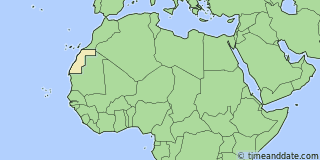

Moonrise, Moonset, and Phase Calendar for 20°46'09.4"N, 17°03'27.6"W, April 2026
Scroll right to see more
| 2026 | Moonrise/Moonset | Meridian Passing | ||||||||
|---|---|---|---|---|---|---|---|---|---|---|
| Apr | Moonrise | Moonset | Moonrise | Time | Distance (mi) | Illumination | ||||
| 1 | - | 7:29 am | ↑ (267°) | 8:04 pm | ↑ (96°) | 1:23 am | (67.8°) | 242,286 | 98.8% | |
 2 |
- | 8:01 am | ↑ (261°) | 8:56 pm | ↑ (103°) | 2:05 am | (61.5°) | 244,472 | 99.9% | |
| 3 | - | 8:35 am | ↑ (255°) | 9:49 pm | ↑ (108°) | 2:48 am | (55.7°) | 246,581 | 98.9% | |
| 4 | - | 9:11 am | ↑ (249°) | 10:42 pm | ↑ (113°) | 3:32 am | (50.5°) | 248,495 | 95.9% | |
| 5 | - | 9:51 am | ↑ (245°) | 11:37 pm | ↑ (117°) | 4:18 am | (46.2°) | 250,074 | 91.1% | |
| 6 | - | 10:34 am | ↑ (242°) | - | 5:06 am | (42.9°) | 251,165 | 84.7% | ||
| 7 | 12:31 am | ↑ (119°) | 11:21 am | ↑ (240°) | - | 5:56 am | (40.9°) | 251,629 | 77.1% | |
| 8 | 1:24 am | ↑ (120°) | 12:11 pm | ↑ (240°) | - | 6:48 am | (40.3°) | 251,350 | 68.4% | |
| 9 | 2:15 am | ↑ (120°) | 1:05 pm | ↑ (241°) | - | 7:39 am | (41.0°) | 250,263 | 59.0% | |
 10 |
3:02 am | ↑ (118°) | 2:00 pm | ↑ (243°) | - | 8:30 am | (43.2°) | 248,361 | 49.1% | |
| 11 | 3:45 am | ↑ (115°) | 2:56 pm | ↑ (247°) | - | 9:19 am | (46.6°) | 245,712 | 39.0% | |
| 12 | 4:25 am | ↑ (110°) | 3:51 pm | ↑ (253°) | - | 10:06 am | (51.2°) | 242,458 | 29.2% | |
| 13 | 5:03 am | ↑ (104°) | 4:47 pm | ↑ (259°) | - | 10:53 am | (56.8°) | 238,815 | 20.0% | |
| 14 | 5:39 am | ↑ (98°) | 5:43 pm | ↑ (266°) | - | 11:38 am | (63.1°) | 235,057 | 11.9% | |
| 15 | 6:15 am | ↑ (91°) | 6:40 pm | ↑ (273°) | - | 12:25 pm | (69.9°) | 231,498 | 5.5% | |
| 16 | 6:52 am | ↑ (83°) | 7:40 pm | ↑ (280°) | - | 1:13 pm | (76.9°) | 228,456 | 1.4% | |
 17 |
7:31 am | ↑ (76°) | 8:43 pm | ↑ (287°) | - | 2:04 pm | (83.6°) | 226,209 | 0.1% | |
| 18 | 8:15 am | ↑ (70°) | 9:50 pm | ↑ (293°) | - | 3:00 pm | (89.6°) | 224,951 | 1.9% | |
| 19 | 9:05 am | ↑ (64°) | 10:59 pm | ↑ (298°) | - | 4:00 pm | (85.8°) | 224,761 | 6.7% | |
| 20 | 10:02 am | ↑ (61°) | - | - | 5:04 pm | (83.1°) | 225,585 | 14.3% | ||
| 21 | - | 12:08 am | ↑ (300°) | 11:05 am | ↑ (60°) | 6:09 pm | (82.5°) | 227,259 | 24.0% | |
| 22 | - | 1:13 am | ↑ (300°) | 12:10 pm | ↑ (61°) | 7:12 pm | (84.1°) | 229,545 | 35.1% | |
| 23 | - | 2:11 am | ↑ (298°) | 1:16 pm | ↑ (64°) | 8:11 pm | (87.5°) | 232,191 | 46.7% | |
 24 |
- | 3:01 am | ↑ (294°) | 2:19 pm | ↑ (69°) | 9:04 pm | (87.8°) | 234,979 | 58.2% | |
| 25 | - | 3:44 am | ↑ (288°) | 3:18 pm | ↑ (74°) | 9:53 pm | (82.2°) | 237,741 | 68.9% | |
| 26 | - | 4:22 am | ↑ (282°) | 4:14 pm | ↑ (81°) | 10:38 pm | (76.1°) | 240,373 | 78.4% | |
| 27 | - | 4:57 am | ↑ (276°) | 5:07 pm | ↑ (87°) | 11:21 pm | (69.8°) | 242,815 | 86.4% | |
| 28 | - | 5:30 am | ↑ (269°) | 5:59 pm | ↑ (94°) | Moon does not pass the meridian on this day. | ||||
| 29 | - | 6:02 am | ↑ (263°) | 6:50 pm | ↑ (100°) | 12:03 am | (63.6°) | 245,039 | 92.7% | |
| 30 | - | 6:36 am | ↑ (257°) | 7:42 pm | ↑ (106°) | 12:45 am | (57.7°) | 247,029 | 97.1% | |
| * All times are local time for 20°46'09.4"N, 17°03'27.6"W. Time is adjusted for DST when applicable. They take into account refraction. Dates are based on the Gregorian calendar. Illumination is calculated at lunar noon. | ||||||||||
Jan | Feb | Mar | Apr | May | Jun | Jul | Aug | Sep | Oct | Nov | Dec
Elsewhere on mungfali.galihkartiwa07.workers.dev

Venus at Peak Brightness
Venus is gearing up for its brightest act of 2026. Find out when and where to see it.

Greenland returns to UTC-3 in 2027
Greenland returns to UTC-3 on October 31, 2027, setting clocks back two hours. The decision follows years of public opposition to the 2023 change.

Sky Guide for November 2026
The planets are putting on a show this month. Up next, Mercury and Venus meet up in the pre-dawn sky.
Full Moon Phase: How Does It Work?
The third primary phase of the Moon is the Full Moon.