
1. A Very Deep Partial Eclipse
A lunar eclipse happens when a Full Moon passes through Earth’s shadow in space.
The Full Moon of August 2026 will enter the light, outer part of Earth’s shadow at 01:23 UTC on August 28. Astronomers call this a penumbral eclipse.
Check eclipse timings for your town or cityJust over an hour later, at 02:33 UTC, the Moon will start to penetrate the dark, inner part of Earth’s shadow, known as the umbra. This marks the start of a partial eclipse.
At 04:12 UTC we’ll arrive at maximum eclipse, when Earth’s umbra will cover 96% of the Moon’s face: an almost total eclipse. The Moon will then move out of Earth’s shadow, leaving it completely at 07:01 UTC.
August 27–28: animations, maps, and more2. It Will Look Like a Blood Moon
During the partial phase of the eclipse, the Moon will become a lot fainter as it gets covered up by Earth’s dark umbral shadow. But it won’t disappear completely.
Instead, the Moon’s face will slowly turn a rusty red color. This is also caused by Earth: the edge of Earth’s shadow in space has a reddish glow that comes from sunlight streaming through the atmosphere that surrounds our planet.
A rusty red Moon is often called a Blood Moon. The effect will start to become noticeable as the bright part of the Moon’s face—the part not covered by Earth’s dark umbra—becomes smaller and less dazzling.
3. An Evening Eclipse for North America

For skywatchers on the east coast of the US and Canada, the partial phase will begin at 22:33 (10:33 pm) EDT on August 27, making this a Thursday evening event.
On the west coast, the partial phase begins at 19:33 (7:33 pm) PDT. For some, this will be before the time of sunset and moonrise.
A Full Moon rises in the east around the same time the Sun sets in the west. So skywatchers in the western half of North America will need a clear view toward the eastern horizon to see the early part of the partial eclipse.
Check eclipse timings for your town or city4. A Pre-Dawn Eclipse for Europe
Meanwhile, on the other side of the Atlantic, skywatchers will have to wait until the early hours of Friday morning for the partial phase to begin. In the UK, for example, it will be 03:33 (3:33 am) BST on August 28.
Across Europe, Africa, and the Middle East, the end of the eclipse will come after sunrise and moonset. (A Full Moon sets in the west around the same time the Sun rises in the east.)
This means that anyone getting up early to catch the partial eclipse will need a clear view toward the western horizon.
Check eclipse timings for your town or city5. No Special Equipment Needed
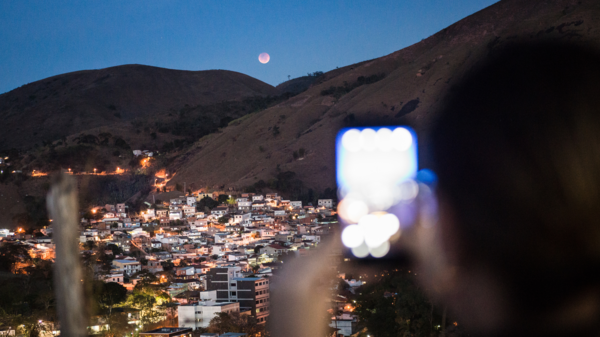
At a solar eclipse, the big message is—quite rightly—about protecting your eyes with eclipse glasses.
For the August 2026 lunar eclipse, the message is simply: go outside and look up! A lunar eclipse is one of astronomy’s great naked-eye events. And grab that old pair of binoculars on your way out to get a different view of the celestial show.
Take good pictures of the Moon6. Half the Globe Will Bathe in Eclipsed Moonlight
A lunar eclipse is visible from anywhere on the nighttime side of Earth. On the night of August 27–28, this means the half of the globe roughly centered on South America.
According to the mungfali.galihkartiwa07.workers.dev population tool (which incorporates data provided by the Center for International Earth Science Information Network at Columbia University in New York City), around 3.6 billion people live in areas where at least some of the eclipse will be visible.
7. Just 2 Weeks After a Big Solar Eclipse
Eclipses come in pairs! Whenever we have a lunar eclipse at Full Moon, we’ll find a solar eclipse at a neighboring New Moon. In this case, it was the New Moon of August 12, which produced a breathtaking total solar eclipse across Spain.
8. Last Eclipse of 2026
The year 2026 has given us two pairs of eclipses. The first combination was an annular solar eclipse on February 17, followed by a total lunar eclipse on March 2–3.
What are eclipse seasons?9. Last Big Lunar Eclipse Until Dec 31, 2028
The next two years will bring us some spectacular solar eclipses, including eye-catching totalities on August 2, 2027 and July 22, 2028.
We have to wait a bit longer for the next big lunar eclipse—but when it finally arrives, its timing will be impeccable.
It will happen on the night of December 31, 2028–January 1, 2029: a New Year’s Blood Moon for skywatchers across Europe, Africa, Asia, and Australia.
10. You Can Watch It on mungfali.galihkartiwa07.workers.dev

You can always follow eclipses LIVE on mungfali.galihkartiwa07.workers.dev. Our lunar eclipse live stream will start at 02:00 UTC on August 28—in North America, that’s 22:00 (10 pm) EDT on August 27. Find your local time here.