Blood Moon at Maximum Eclipse
Partial Lunar Eclipse Highlights
A Very Deep Partial Eclipse
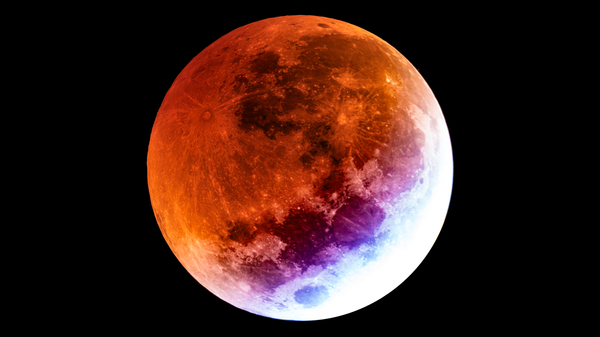
At maximum eclipse on August 27–28, Earth’s dark umbral shadow will cover 96% of the Moon’s face: an almost total eclipse.
10 things to know about the August 2026 lunar eclipseWhere Will Our Mobile Observatory Be?
Our timeanddate mobile observatory team for this eclipse—Steffen Thorsen and Konstantin Bikos—are tracking the weather forecasts, and currently targeting a location near Seville, Spain.
Meanwhile, if the clouds cooperate, Adrianna Opyrchal will be setting up one of our other telescopes near the timeanddate HQ in Stavanger, Norway.
Teaming Up with Old Friends
We’re going to be reuniting with some of a number of long-time collaborators for this eclipse.
South America
This will be our sixth live stream collaboration with Thomas Puzia and his team from the Institute of Astrophysics in Santiago, Chile. Thomas has also shared the excitement of interstellar comet 3I/ATLAS with us—his team was among the first groups to gather data on this exotic visitor from beyond the solar system.
We’ll be reuniting, too, with our old friend Ángela Pérez, an astronomer and educator based in Colombia. We last worked with Ángela at the October 2023 annular eclipse across North and South America. For this eclipse, we’ll also be working with Andrés Torres at the Instituto Tecnológico Metropolitano in Medellín; María Gracia Batista at the Universidad de los Andes in Bogotá; and Mario Vargas at Campamento Interestelar Orion in Colombia’s Tatacoa Desert.
North America
Meanwhile, on the west coast of North America, we’re getting together once again with our old partner Gary Hawkins of the San Diego Astronomy Association. This will be our eighth (8th!) live stream with Gary.
And just two weeks after we joined up with Chris Curwin in Saint John, Canada, for the solar eclipse on August 12, Chris hopes to send us live pictures from the August 27–28 lunar eclipse! Saint John is located on the Bay of Fundy, famous for having the highest tidal range in the world. Once again, Chris will be accompanied by astronomer Mike Powell.
Europe
Plus, weather permitting, we’ll be getting a UK feed from Neill Sanders at Go Stargazing . Along with his colleague Grant Bowskill at First Light Optics , Neill has been extremely busy recently helping the UK prepare for the big partial solar eclipse on August 12. (For the eclipse itself, Neill was off the coast of Greenland, from where he did a memorable interview with the BBC.)
Across the North Sea, Steinar Thorvaldsen and our friends at the Agder Astronomy Society may stream the eclipse from southern Norway—but, again, this will depend on cooperation from the weather...