
No More Leap Seconds
On October 15, 2026, the General Conference on Weights and Measures (CGPM) in Paris approved a resolution to allow the difference between civil time (UTC) and solar time (UT1) to increase from 1 second to 1 hour. This means there will not be any more leap seconds.
The last ever leap second was added at the end of December 31, 2016.
Read more about the abolition of leap secondsA negative leap second would have been a second that was subtracted from our clocks to keep them in sync with the Earth’s rotation. It is the opposite of a positive leap second, which is a one-second addition to our clocks.
The system of leap seconds was introduced in the early 1970s. There were 27 positive leap seconds, but no negative leap seconds. This is because the Earth’s rotation is generally slowing down.
At the beginning of the 2020s, however, the Earth’s rotation speeded up—raising the possibility that a negative leap second may have been required at some point.
A Minute with 59 Seconds
The International Earth Rotation and Reference Systems Service (IERS) monitors the Earth’s rotation, and took decisions on when to add or subtract a leap second.
The IERS aimed to keep Coordinated Universal Time (UTC)—which is what our clocks use—within one second of Universal Time (UT), which is based on the Earth’s rotation. UTC is linked to the super-steady beat of International Atomic Time (TAI).
If the Earth’s spin had gotten too far ahead of our clocks, a second would have been taken away from UTC. In practice, this negative leap second would have meant our clocks skipped a second, and advanced from 23:59:58 straight to 00:00:00.
Traditionally, leap seconds occurred on the last day of June or the last day of December.
Is the Earth Speeding Up or Slowing Down?
On average, the Earth takes 24 hours—one mean solar day—to complete one rotation with respect to the Sun. While this translates to 86,400 seconds on paper, the Earth’s rotation is not constant, so most days are fractionally longer or shorter than that.
The following chart shows how the Earth’s rotation varied between 1830 and 2020.
The green line indicates the difference, in milliseconds, between the Earth’s rotation and 86,400 seconds. The orange line is the overall trend across the 190-year period.
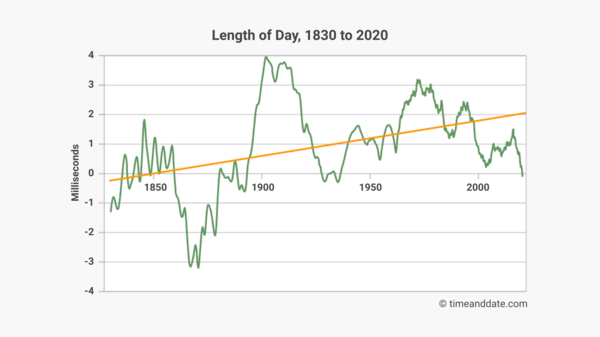
The orange trend line shows that, over the course of a century, the Earth’s rotation is gradually slowing. This is a result of tidal friction caused by the Moon. For instance, the twice-daily sloshing of the ocean tides takes away a tiny part of the Earth’s rotational energy.
On the other hand, the green line tells us that, over the course of a decade, the Earth‘s rotation is unpredictable. The reason for this is the complicated motion of—among other things—the Earth’s oceans, atmosphere, and molten core.
In 2016, for instance, the Earth took 1.34 milliseconds longer, on average, than 86,400 seconds to complete one rotation. But across the whole of 2020, the Earth took a fraction of a millisecond less than 86,400 seconds to rotate once.
How long is a day on Earth? Planet Earth is an exceptionally accurate timekeeper Speaking of time “leaps:” Is time travel possible?Why Are There No Negative Leap Days?
Leap days are always positive because the Earth consistently—within half an hour or so—takes about a quarter of a day longer than 365 days to go round the Sun. Over a four-year period, these quarter-days add up to a full extra day: February 29.
Just imagine, however, if the solar system was arranged so the Earth took a quarter of a day less than 365 days to go round the Sun. In this imaginary situation, we would have negative leap days, and our calendar would advance straight from February 27 to March 1 every four years.
Is there a perfect calendar?