This eclipse wasn't visible in Columbus - Which upcoming eclipses can be seen in your location?
Where the Eclipse Was Seen

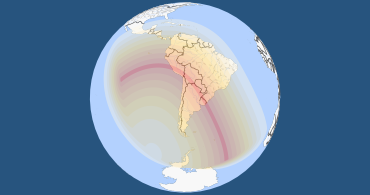
Try our new interactive eclipse maps. Zoom in and search for accurate eclipse times and visualizations for any location.
Path of the Eclipse Shadow
Regions that saw, at least, a partial eclipse: South in North America, South America, Pacific, Atlantic, Antarctica.
This eclipse wasn't visible in Columbus - Which upcoming eclipses can be seen in your location?
Eclipse Shadow Path
0%
>0%
40%
90%
100%
The dark areas symbolize night and twilight.
When the Eclipse Happened Worldwide — Timeline
The eclipse started at one location and ended at another. The times below are actual times (in UTC) when the eclipse occurred. This calculation uses a Delta T value of 29.9 seconds.
| Eclipse Stages Worldwide | UTC Time | Local Time in Columbus* |
|---|---|---|
| First location to see the partial eclipse begin | Aug 20 at 12:21:57 | Aug 20 at 8:21:57 am |
| First location to see the full eclipse begin | Aug 20 at 13:36:08 | Aug 20 at 9:36:08 am |
| Maximum Eclipse | Aug 20 at 15:13:07 | Aug 20 at 11:13:07 am |
| Last location to see the full eclipse end | Aug 20 at 16:49:39 | Aug 20 at 12:49:39 pm |
| Last location to see the partial eclipse end | Aug 20 at 18:03:57 | Aug 20 at 2:03:57 pm |
* These local times do not refer to a specific location but indicate the beginning, peak, and end of the eclipse on a global scale, each line referring to a different location. This eclipse isn't visible in Columbus.
Upcoming eclipses visible in Columbus
Next Annular Solar Eclipse will be on Jan 5, 1954
Eclipse calculations usually accurate to a few seconds
Countries Where the Eclipse Is Visible
| Country | Type | Start of Eclipse | End of Eclipse |
|---|---|---|---|
| Argentina |
|
10:21 am | 2:34 pm |
| Bolivia |
|
8:53 am BOT | 1:11 pm BOT |
| Brazil |
|
8:39 am AMT | 2:38 pm BRT |
| Chile |
|
8:06 am PET | 1:17 pm CLT |
| Paraguay |
|
9:25 am PYT | 1:27 pm PYT |
| Peru |
|
7:30 am PET | 11:43 am PET |
| Uruguay |
|
10:57 am UYT | 2:37 pm UYT |
| Anguilla |
|
9:13 am AST | 10:40 am AST |
| Antarctica |
|
2:41 pm | 5:40 pm |
| Antigua and Barbuda |
|
9:11 am AST | 10:48 am AST |
| Aruba |
|
8:13 am | 10:39 am |
| Barbados |
|
9:09 am AST | 11:11 am AST |
| Belize |
|
6:32 am CST | 8:31 am CST |
| British Virgin Islands |
|
9:09 am AST | 10:40 am AST |
| Caribbean Netherlands |
|
8:16 am | 10:43 am |
| Cayman Islands |
|
7:44 am EST | 9:27 am EST |
| Colombia |
|
7:26 am COT | 11:08 am COT |
| Costa Rica |
|
6:23 am CST | 9:05 am CST |
| Cuba |
|
7:49 am CST | 9:29 am CST |
| Curaçao |
|
8:14 am | 10:42 am |
| Dominica |
|
9:08 am AST | 10:59 am AST |
| Dominican Republic |
|
7:51 am EST | 9:44 am EST |
| Ecuador |
|
7:22 am | 10:49 am ECT |
| El Salvador |
|
6:28 am CST | 8:42 am CST |
| Falkland Islands |
|
10:34 am FKT | 1:32 pm FKT |
| French Guiana |
|
9:15 am GFT | 12:04 pm GFT |
| Grenada |
|
9:00 am AST | 11:17 am AST |
| Guadeloupe |
|
9:10 am AST | 10:55 am AST |
| Guatemala |
|
6:29 am CST | 8:36 am CST |
| Guyana |
|
9:11 am | 12:21 pm |
| Haiti |
|
7:48 am EST | 9:41 am EST |
| Honduras |
|
6:28 am CST | 8:43 am CST |
| Jamaica |
|
7:43 am EST | 9:39 am EST |
| Martinique |
|
9:07 am AST | 11:03 am AST |
| Mexico |
|
6:30 am CST | 8:31 am CST |
| Montserrat |
|
9:10 am AST | 10:50 am AST |
| Nicaragua |
|
6:27 am CST | 8:55 am CST |
| Panama |
|
7:26 am EST | 10:17 am EST |
| Pitcairn Islands |
|
6:13 am | 6:34 am |
| Puerto Rico |
|
8:59 am AST | 10:44 am AST |
| Saint Helena |
|
3:46 pm GMT | 6:00 pm GMT |
| Saint Kitts and Nevis |
|
9:11 am AST | 10:47 am AST |
| Saint Lucia |
|
9:06 am AST | 11:07 am AST |
| Saint Martin |
|
9:13 am AST | 10:41 am AST |
| Saint Vincent and the Grenadines |
|
9:02 am AST | 11:14 am AST |
| Sint Maarten |
|
8:43 am | 10:11 am |
| South Georgia/Sandwich Is. |
|
1:04 pm GST | 3:56 pm GST |
| St. Barts |
|
9:13 am AST | 10:42 am AST |
| Suriname |
|
9:34 am | 12:35 pm |
| The Bahamas |
|
7:59 am EST | 9:24 am EST |
| Trinidad and Tobago |
|
8:57 am AST | 11:26 am AST |
| Turks and Caicos Islands |
|
8:04 am EST | 9:22 am EST |
| US Minor Outlying Islands |
|
7:48 am EST | 9:37 am EST |
| US Virgin Islands |
|
9:06 am AST | 10:45 am AST |
| United States |
|
7:08 am CST | 9:54 am EDT |
| Venezuela |
|
8:05 am VET | 11:30 am VET |
All times shown in this table are local time. (Note: more than one time zone is listed.)
How Many People Can See This Eclipse?
| Number of People Seeing... | Number of People* | Fraction of World Population |
|---|---|---|
| Any part of the eclipse | 169,000,000 | 6.55% |
| At least 10% partial | 127,000,000 | 4.94% |
| At least 20% partial | 111,000,000 | 4.29% |
| At least 30% partial | 91,500,000 | 3.53% |
| At least 40% partial | 81,800,000 | 3.16% |
| At least 50% partial | 63,100,000 | 2.44% |
| At least 60% partial | 45,500,000 | 1.76% |
| At least 70% partial | 33,000,000 | 1.28% |
| At least 80% partial | 23,800,000 | 0.92% |
| Totality or annularity | 7,080,000 | 0.27% |
* The number of people refers to the resident population (as a round number) in areas where the eclipse is visible. timeanddate has calculated these numbers using raw population data provided by the Center for International Earth Science Information Network (CIESIN) at Columbia University. The raw data is based on population estimates from the year 2000 to 2020.

An Eclipse Never Comes Alone!
A solar eclipse always occurs about two weeks before or after a lunar eclipse.
Usually, there are two eclipses in a row, but other times, there are three during the same eclipse season.
This is the second eclipse this season.
First eclipse this season: August 5, 1952 — Partial Lunar Eclipse