-
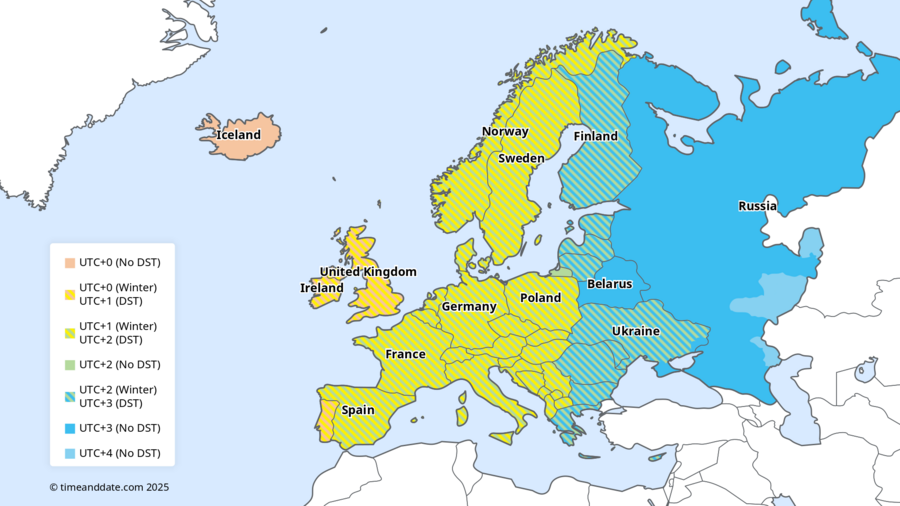
The European continent spans four main standard time zones.
-
CET (UTC+1) is the most widely used zone.
-
Most EU countries change their clocks for DST; Russia, Iceland, and Belarus do not.
This summary was generated automatically and reviewed for accuracy by the article’s author. All of our content follows strict editorial guidelines. Was this helpful? Let us know.
How Many Time Zones Are There in Europe?
The European continent spans four standard time zones from Iceland in the west to parts of Russia in the east. Most of Europe uses three standard time zones: Western, Central, and Eastern European Time. They sit one hour apart, so a trip from Lisbon to Berlin to Athens only ever shifts your watch by one hour at a time.
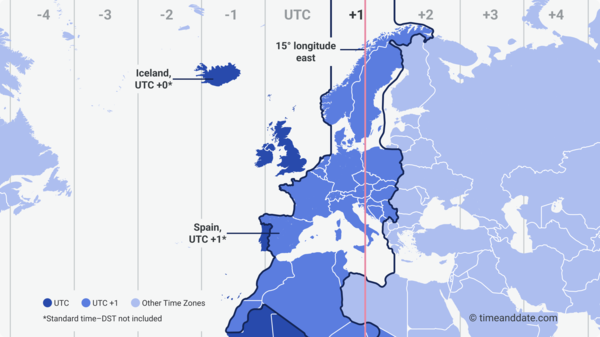
However, there are also some exceptions to the simplicity: often the geographical location, rather than the Sun, determines which time zone a country uses. For example, although sunrise and sunset times differ considerably in mainland Spain, France, and Poland, they all share the same time zone.
Current local times in EuropeThe European continent spans four main standard time zones:
UTC+1: Central European Time (CET)
Central European Time is UTC+1, or UTC+2 during the DST period (Central European Summer Time). It is the most widely used time zone on the continent. It runs from Spain and France across to Germany, Italy, Poland, and Norway. Spain’s use of UTC+1 puts it well east of its natural longitude, which is why its sunsets come so late.
UTC+0: Western European Time (WET)
Western European Time is UTC+0, or UTC+1 during the DST period (Western European Summer Time). The UK and Ireland follow the same UTC offsets but use different time zone names. UTC+0 covers the UK, Ireland, Portugal, and the Canary Islands. Iceland also uses UTC+0 year-round, with no shift to Daylight Saving Time during summer.
UTC+2: Eastern European Time (EET)
Eastern European Time is UTC+2, or UTC+3 during the DST period (Eastern European Summer Time). It applies in countries such as Finland, the Baltic states, Greece, Romania, Bulgaria, and Ukraine.
UTC+3: Moscow Time (MSK)
Moscow and Belarus use UTC+3 and Moscow Time (MSK) all year, while Turkey follows Turkey Time (TRT). None of them changes their clocks for Daylight Saving Time.
Daylight Saving Time (DST) in Europe
Most European countries coordinate their time change. Under current EU law, Directive 2000/84/EC , DST runs from 01:00 UTC on the last Sunday of March to 01:00 UTC on the last Sunday of October every year.
Daylight Saving Time (DST) in EuropeParticipating countries are:
Countries that do not observe DST include Russia, Iceland, and Belarus.
Current local times in EuropeDST Starts and Ends at Different Local Times
While the switch occurs at the same UTC time in all participating countries, local times vary because Europe has several time zones. For example, DST starts at 02:00 (2 am) local standard time in countries like France and Germany, while Finland and Greece advance their clocks at 03:00 (3 am) local time.
To find out local times for all European countries, please see the table below or enter a country into our DST search.
Upcoming DST changes worldwide
Shorter than in the US and Canada
The US (except for Hawaii and most of Arizona) and the provinces and territories in Canada that observe DST will end it a week after Europe, on November 1, 2026.
US clock change in detailDST in Europe is 21 or 28 days shorter than in the US and Canada, depending on the year.
Europe’s Four Main Time Zones
| Western Europe | Central Europe | Eastern Europe | Belarus and Western Russia |
|
|---|---|---|---|---|
| Standard time |
Same as UTC |
UTC+1 |
UTC+2 |
UTC+3 |
| Daylight Saving Time (DST) |
UTC+1 |
UTC+2 |
UTC+3 |
No DST |
|
Example places
|
Including Iceland* (on GMT all year), Ireland*, Portugal (mainland), and United Kingdom*. |
Including France (mainland), Germany, Italy, Norway, Poland, and Spain (mainland). |
Including Belarus, and most of the European part of Russia. |
|
| DST starts | At 01:00 (1 am) local time, clocks go forward to 02:00 (2 am), except in Iceland. | At 02:00 (2 am) local time, clocks go forward to 03:00 (3 am). | At 03:00 (3 am) local time, clocks go forward to 04:00 (4 am). | No DST |
| DST ends | At 02:00 (2 am) local time, clocks go back to 01:00 (1 am), except in Iceland. | At 03:00 (3 am) local time, clocks go back to 02:00 (2 am). | At 04:00 (4 am) local time, clocks go back to 03:00 (3 am). | No DST |
Frequently Asked DST Questions
Why does Portugal have a different time zone from Spain?
Most of Spain is west of the prime meridian (0 degrees longitude), the basis for UTC. Other countries close to the meridian, such as the UK and Portugal, have standard times matching UTC.
The most natural time zone for Spain would be Western European Time (same time as UTC), but it is, in fact, UTC+1 during standard time and UTC+2 during Daylight Saving Time.
It all dates back to the Second World War when Spanish Fascist dictator Francisco Franco changed the time zone in Spain so the country would be in the same time zone as Germany, and to save energy for the war effort. After the war, other countries returned to their old time zone, but Spain stayed on UTC +1.
Why does Europe call it “summer time” instead of Daylight Saving Time?
Saying “summer time” instead of Daylight Saving Time (DST) is common in many countries, like the United Kingdom. The term winter time is sometimes used instead of standard time, which is the official name for the period without DST.
What is the time difference between Europe and the US?
Europe is between 5 and 9 hours ahead of the United States, depending on where you are. For example, Central European Time (Berlin, Paris, Madrid) is 6 hours ahead of New York and 9 hours ahead of Los Angeles.
The difference shrinks by one hour for a few weeks in March and in late October to early November, when Europe and the US change their clocks for DST on different dates.